Translate

Thursday, May 5, 2016

Viewing The Endangered Sierra Nevada Bighorn Once Again


Dale Matson

Click On Photographs To Enlarge
I can't Imagine Trying To Walk Through This

Well, if you have followed the articles I’ve written over time and more frequently recently, you might be asking yourself, “Has he gone from veneration to worship?” Steve Yeager calls it, “Sheep Fever”.

Sharon accompanied me to the east side of the Sierra Nevada this week and it was less burdensome to have her along sharing the 6-hour drive from Fresno to Bishop via Tehachapi Pass.

Sharon

Our plan was to look near Mt. Whitney where I had previously gotten some wonderful close photographs of a group of sheep. We then would look near Black Canyon south of Aberdeen and finally head up to Bishop for an overnight. We were scheduled to meet Steve Yeager at his place the following morning and look for sheep along Pine Creek Road. Here is a previous article on Steve. http://midsierramusing.blogspot.com/2016/04/sierra-nevada-bighorn-sheep-steve.html

I had high hopes for the site near Whitney but as we walked up the trail, it was obvious that there were no fresh tracks or scat to indicate recent sheep activity. It is a steep trail up and down but as we left, we remained hopeful that the site south of Aberdeen would have sheep. We used our binoculars for quite some time, moved further north and eventually crossed a creek and climbed about 700’. There was still no recent evidence of sheep there either. This was my third attempt with no sightings at this location. It doesn't mean the sheep weren't there. We once saw a herd of about 50 deer in that area. The CDFW places transmitter collars on some sheep, which helps them locate the sheep, but we only have our eyes aided by binoculars, which are not nearly as attuned as Steve or Dr. Wehausen.

 Inyo Mountains To The East

Can You See A Sheep? We Couldn't Either

After an overnight stay and breakfast, we headed to Steve’s place to meet up with him for the trip up Pine Creek Road above Rovana. We had two stops along the road as we climbed. Steve spotted four juvenile sheep at the third stop. There was also a young ram above them. I got plenty of photographs with my Tamron 150-600mm lens adapted to a Sony A7R2.


Steve claimed the four juveniles were on their own because their mothers were preoccupied with new lambs that they had birthed higher up. By going very high, the mothers protect the new lambs, which have also no scent, by making them less vulnerable to predators. In the meantime, these four juveniles were footloose and fancy free with deeds of “derring do”. We watched one jump off a 30’ cliff and of course, the others followed suit. Steve thinks that some of the young mortality is connected to this kind of risk taking.


Steve Guestimated That This Was About A Thirty Foot Jump

We continued to drive higher in hopes of getting closer but the young sheep seemed uncustomary wary at this distance and moved higher also, keeping us far apart. In all Steve and Sharon saw four juveniles, two ewes and two young rams. I never did see the ewes in the willows.


White Mountain Peak To The East

 Young Ram One
 Young Ram Two
Skyline Shot Of Barely Visable Sheep

We walked above the gate toward the mine taking more photographs with me getting a shot of a second young ram. I included a skyline shot that should indicate just how difficult is to see these sheep unless the background rocks contrast with their coats. These sheep all had white coats.

Sharon's Photograph Of Steve And I Walking
The Captivating Beauty Of Sheep Country
And Of Course Mighty Mount Whitney

We talked to the tungsten mine maintenance men and they noted that they had several mountain lion and bobcat sightings and the group of nineteen had scattered after that. This was Sharon’s first time to see the sheep and she was able to spot one on her own. It was so rewarding once again to see these wonderful endangered animals and I wish the mountain lions and bobcats would stick to a diet of mule deer.

We stopped back at Steve’s place and my Sharon met his Sharon. Homebound, we stopped near Mt. Whitney again but saw no fresh evidence of sheep. My gusher from the week before had become a dry hole so to speak.


Monday, April 25, 2016

Sierra Nevada Bighorn Sheep: Not So Close


Dale Matson

Click On Photographs To Enlarge

The day following my close encounter with a group of Bighorn Sheep from the Langley Herd Unit, http://midsierramusing.blogspot.com/2016/04/the-endangered-sierra-nevada-bighorn.html

I had a chance to go out with Steve Yeager, the man with more photographs of Sierra Nevada Bighorn Sheep than any other person. The CDFW uses a lot of his photographs. We headed up Pine Creek Road north of Bishop and did considerable scouting beginning with the area just above the small community of Rovana. These are the bighorn sheep from the Wheeler Ridge Unit.

This area along Pine Creek Road between Rovana and where the road ends in a parking area/trailhead below the closed tungsten mine is where sheep from the Wheeler Ridge Herd Unit can be observed during the winter. I had been along this route on two previous occasions and was able to get photographs both times although the sheep are usually high above the north side of the road.

I noticed more rock climbers parked along Pine Creek Road this time. It was a cool morning and it didn’t take Steve long to locate some sheep with his Swarovski binoculars. There were two adult ewes and two juveniles walking up the bronze colored talus. Because their coats were white, this rock color made them more visible. Most of the time the rocks are white and it is even more difficult to find them unless you notice movement.

These sheep are much further away and essentially invisible to the unaided eye. That is often the main problem with photographing bighorn sheep from a distance. If you need binoculars and/or a spotting scope, even a 600mm camera lens will not give you an up close look at the sheep. I have cropped these photographs to make the sheep appear larger. It is useful however to see the real estate surrounding these sheep. The video slideshow I uploaded to YouTube shows the sheep un-cropped using a 600mm lens. https://www.youtube.com/watch?v=1qJVVQcpFA4

We stayed there for a while and Dennis a professor at the local community college; a Rovana local, stopped his truck to talk to Steve. He has a huge telescope in his backyard and can scan the slopes for quite a distance. I had to laugh at the three dogs inside the cab with him. Dennis and Steve have “Sheep fever” and Dennis keeps daily records of sheep counts and movement.

Eventually the sheep worked their way out of sight and we went elsewhere. After scanning for about 1.5 additional hours and no further sightings, I had to leave for home.

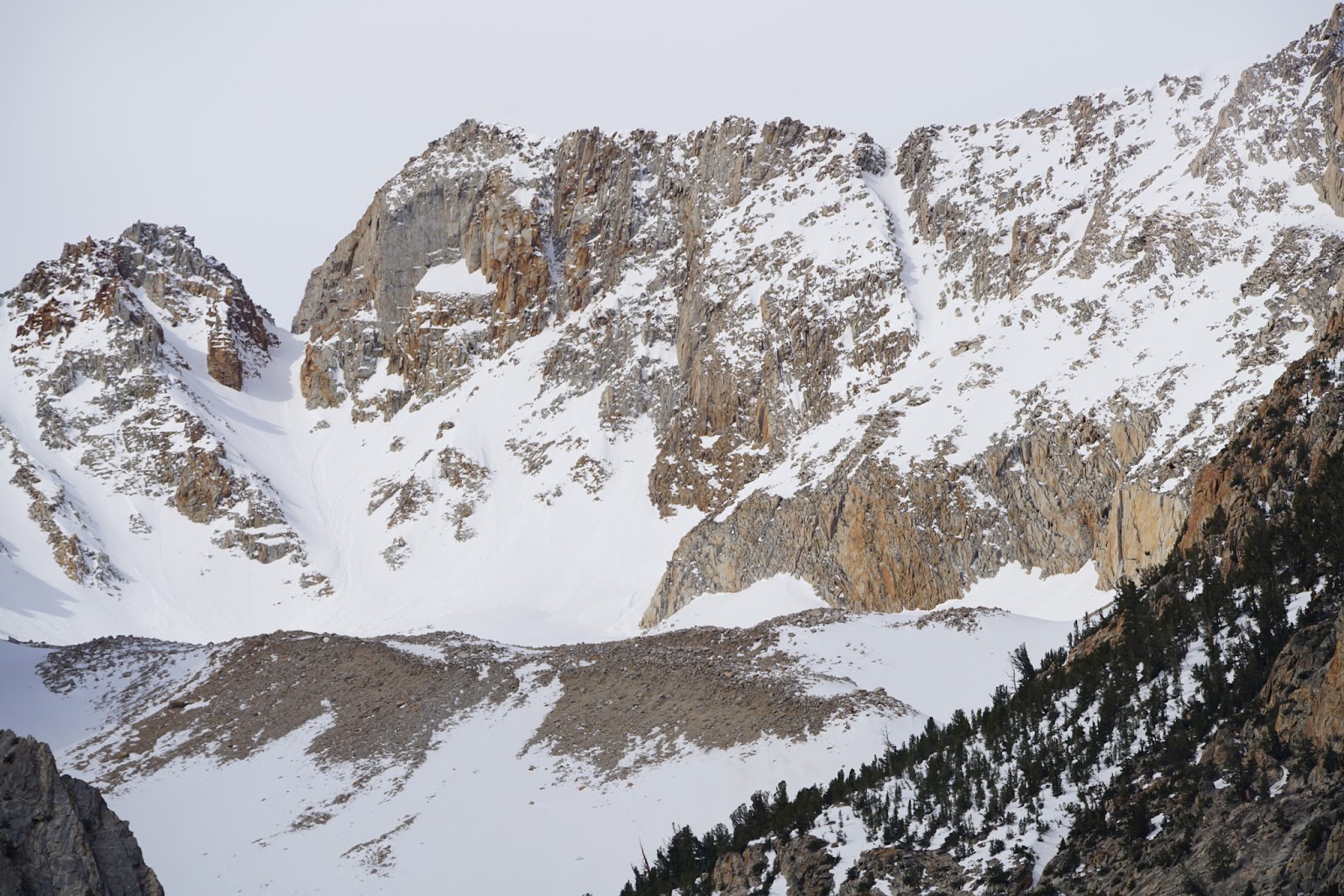
Wildlife photography sure takes more patience than landscape photography. It always seems like the animals want to walk behind something that obscures your viewing them. The photographs were taken with a Sony A7R2 with an adapted Tamron 150-600mm lens. I have also included some mountain scenery from the same area where I photographed the bighorn sheep.


Friday, April 22, 2016

The Endangered Sierra Nevada Bighorn Sheep: Close Up


Dale Matson

Click On Photographs To Enlarge

Ewe
I have been backpacking for three years across and over Bighorn Sheep territory in the Sierra Nevada looking for sheep. I have seen tracks and scat and briefly saw two sheep on the 60 Lake Basin trail. More recently I have had three organized opportunities to photograph sheep from the Mt. Langley and Wheeler Ridge herds. Each of the last three times, on field trips with Dr. Wehausen, The CDFW and finally Steve Yeager, I have had the opportunity to see and photograph sheep.

I have been on a slow learning curve and only gradually upgraded to bigger and bigger telephoto lenses. Actually, the Tamron 150-600mm lens I now have, I bought just before heading back to the Bishop area to look for sheep again this week with Steve Yeager. Go big or go home! He is in a different league when it comes to a 6th sense about where the sheep are. He claims (and I believe him) that he can smell the sheep before he sees them. I believe this Bishop native has more Sierra Nevada Bighorn Sheep photographs than any other person. The late Galen Rowell has a wonderful photograph of a ram in the Mountain Light gallery in Bishop. He set the quality standard and it was Dr. Wehausen that took him to the place where he took the photograph.

As I was heading north on Highway 395 south of Lone Pine, I called Steve to say I was on the way. We were scheduled to look for sheep together the following morning. He told me of a location to check out near Lone Pine and I thought it would make good sense before finishing the drive to Bishop to stay for the night.

Thus began another adventure with me parking my 4X4 Silverado way too soon. I climbed on a trail for another mile but noticed lots of sheep tracks and some mountain lion tracks too. I could see sheep trails running at an angle up the steep canyon sides. Eventually, I could see human boot prints and assumed it was where Steve had begun walking up the trail. I then followed both the sheep and Steve’s tracks. He said I would come to a point where I would look to my right. I was carrying my new lens on a shoulder strap connected to the tripod collar and the climb was becoming warm.

As I looked to my right, I clearly saw a ewe standing on top of a boulder about 300 feet away. It is so different when you are alone and have such a close encounter. I had seen lots of sheep from a distance but this was qualitatively different. I slowly lifted my Sony A7R2, turned it on and took a few photographs thinking at the time, “This may be it”.  As I continued up the trail, there were more sheep, about eight or nine with one young ram a couple of juveniles and ewes.

I spent an hour taking over 100 photographs at various focal lengths. At one point I was able to kneel down and rest the heavy telephoto lens on a boulder to steady it and take the weight off my arms. The problem was that the sheep, which were less than one hundred feet from me, all began to lay down and the thick grass and brush concealed all but their heads.

I got up and took more photographs realizing how much more difficult wildlife photography is than landscape photography. The sheep were comfortable enough to actually walk toward me as they grazed. I did remember the cardinal rule which is get close and then get closer. I had a sense that the distance I had established was at the edge of their comfort zone and as I edged closer they began to move away.


It was a wonderful experience, one that for me may never again be duplicated. I was able to appreciate first hand the harsh environment in which these endangered sheep live out their existence. In summer they are in even harsher, higher and safer (from predators) elevations.  They are rugged yet fragile. I left with thankfulness and respect. I hope you will share in my enjoyment as you view the photographs.


 Juvenile Sheep
Mountain Lion Tattoo On Young Ram

There is a YouTube video here:
https://www.youtube.com/watch?v=JdMdbhOiiuk